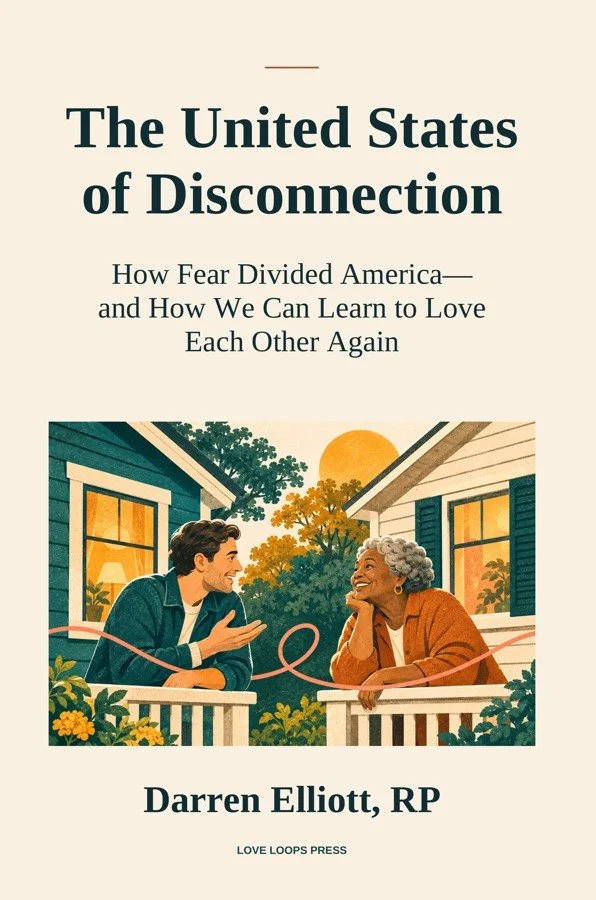
The United States of Disconnection
How Fear Divided America—and How We Can Learn to Love Each Other Again
By Darren Elliott · Love Loops Press
Read It Together · Free book resources
I started writing this book because I wanted to understand what happened in my own family. As I trained to become a psychotherapist, I began to recognize a familiar pressure in American public life. What happens when staying on somebody’s side means keeping quiet about what hurts?
The book follows that question from the kitchen table to the public square. It also gives us something to try the next time a conversation starts to go sideways.
Read a sample
From the full edition’s introduction, “We All Belong”
I am Canadian, and this is a love letter to America.
I grew up in New Brunswick and visited the United States often, including winter trips to Florida. I have spent months in America over the years; one year I came close to the six-month visitor limit. Some of my chosen family live there. Many of those friendships began while I was living in Japan, and they have lasted for decades.
I have celebrated birthdays with friends in Georgia, visited people I love in Texas, and sat around kitchen tables where ordinary conversations turned into lasting memories. I have shared laughter and worry with Americans. When I write about what is happening in the United States, I am writing about people I care about, not strangers in a country I only know from the news.
How do people who care deeply about their own families come to fear other people’s families? I kept returning to that question as I watched American public life. People could be generous toward those they knew, then defend cruelty toward people they had never met. I recognized something familiar in the pressure to choose loyalty over what we could see for ourselves.
Read it together
You can start on your own, with a friend, or with a book club. Ask: When have I felt free to disagree and still know I belonged? What made that possible? Give each person room to answer or pass. Before you finish, name one thing you could do to give somebody else that same freedom.
Questions readers bring to the book
Why are we so divided, even in our own families?
The book looks at how fear, loyalty and the wish to belong can make it harder to ask honest questions. Family dynamics can help us recognize a pattern. Public institutions, history and access to power also shape what happens. Start by asking who can disagree without being punished.
How do I talk to family about politics without a fight?
Try having one smaller conversation. Ask what experience made the issue matter to them and reflect back what you heard before you reply. You can say where you disagree or stop if the exchange becomes degrading or unsafe.
What is a Love Loop?
Love Loops™ is my educational framework for putting care into action. In a disagreement, that might mean noticing that you’re getting defensive, pausing, listening and returning to do something differently. Start with one step you can actually keep.
How do I repair a relationship after an argument?
Begin with the part you can own. “I talked over you when you were trying to explain. I’m sorry. If you want to finish, I’ll listen.” Their answer might be “later.” Respecting it is part of the repair.
What if the other person won’t listen?
You can choose what you’re willing to discuss, where you’ll stop and who can support you. Nobody owes someone another conversation. If there are threats, control or fear of retaliation, prioritize safety and seek appropriate support.
Which edition should I look for?
The full edition has more stories, context and practices. The shorter edition is in development. The reading prompt above works with the full edition or the sample on this page.
Keep reading and practising
Find the reader guides and discussion questions, or explore the wider Narcissism Recovery Project.
These reading and conversation resources are for education and reflection.